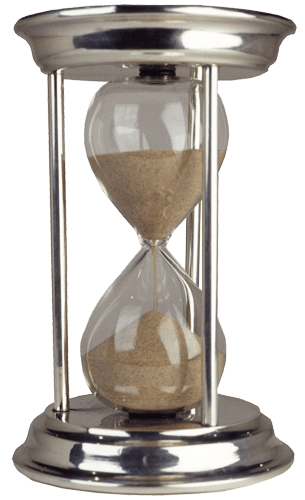
The image of an hour glass in which the last grain of sand slips from the upper chamber into the lower is ubiquitous. But is it an accurate image of how we experience time?
We can see the movement of physical material falling with gravity, then when there is no more to fall, all movement stops and we say,”Time has run out.” What does that even mean? We know you can turn the hourglass over and ‘time’ begins again. Really? Time begins again? Now, we don’t need to delve into Einstein’s theory of time/space relativity (which is fascinating) to critique the time concept model of the hour glass. We understand that time doesn’t run out. What we are attempting to do is manage the amount of time we spend doing one ‘task’ or the other.
Next question. Does one task have to be completed before another can begin? Hourglass relay? If we say, “no,” then we can argue whether multitasking is a more efficient or less efficient ‘use’ of time.
Next question. Do we actually ‘use’ time? Can it be ‘used up’? Think back to the hourglass question. So what is our relationship with time? Can we make it stand still? Can we make it speed up? Can we make it do anything at all, really? Can we ‘divide’ it? with schedules and deadlines? What characteristic of time does that imply? Do we ever even ‘have’ time? What is ‘never?’ Is ‘never’ marked by the space in which we die. What exactly is ‘not yet?’
In this last year of unexpected and lonely deaths, we have heard, “I didn’t even get to see them before they died.” We know that means that the loved one could not be in the same space as the dying one and go through their death with them, but they DID get to see them before they died at some point in the past, or they would have not known them.
Human societies have long known the value of marking certain life events with sacred rituals: births, unions, separations, transformations, conversions, deaths. These points along our lives become markers for ‘before’ and ‘after.’ These are the ways we create chapters in our tales of our story which we transfer from one generation to the next.
Regrettably, my observation has been: we sometimes stop and close a chapter because we perceive a time limit that does not really exist. Can time run out for anything? Will time run out for everything? The saying, “you can never go back.” is often accepted as a maxim. But is it? If we view time as a river, it may requires more energy to move upstream, but boats and even swimmers can do it. Might we view our time more as an ocean? It is huge, but movement is not linear. It is so expansive that returning to the same spot is not as probable, but it isn’t impossible, nor does it always require extraordinary energies. It requires only remembering where you have been. So our problem with revisiting a place in our past to continue our time there is more about not paying enough attention while we are there to find our way back (or to avoid being there again if that is best). And that is why our time is better ‘spent,’ (which we cannot actual do because we don’t own it anyway!) living in one moment at a time.

As a teacher, I always wanted more contact time with my students. There was never enough time to experience all the vast music I hoped to introduce to them. I did not realize that the most important function of time was the space I was in right then, not what I might have tomorrow. Teachers, by nature, plan ahead for future moments in each year, week and day, and that should not stop. Of primary importance, I believe, is remembering the moments we are in, no matter the schedule. We all give lip service to the notion that living like “this might be the last day of your life,” is a valuable exercise. But that is a passing exercise and if it does turn out to be true for someone, they cannot learn from it, because they aren’t alive to think about it.
But what might be the potential in learning how we can live our life as if everything we do matters to someone? Maybe time is essentially love itself and to ‘use’ what time we ‘have’ is to embody as much life giving compassion as we are able. Be grateful, “thank you.” Be generous, “here, this is for you.” Be ears, “tell me more.” Be a tool, “how can I help.” Be…Be…Be….Not hold on as long as you can: not 90 years, 70 years, 50 years, 30 years until your time runs out. Time will not run out. Tragically we may quit ‘being’ without ever really finding out what we are being for. So… Stop! You must make your schedule be still! Time will never stand still, so we must stop running to catch up with some imaginary train that may leave without us. That train is not real. That train is not life. Nothing is leaving without us. We are only where we are. We can choose from a huge ocean of spaces to live in, but time is not a prescient value. In order to thrive we must watch, not a clock, but how we live and move and have our being.
Live for serving. Move into creativity. Be present.
These will never run out.

 RecapitulationSong